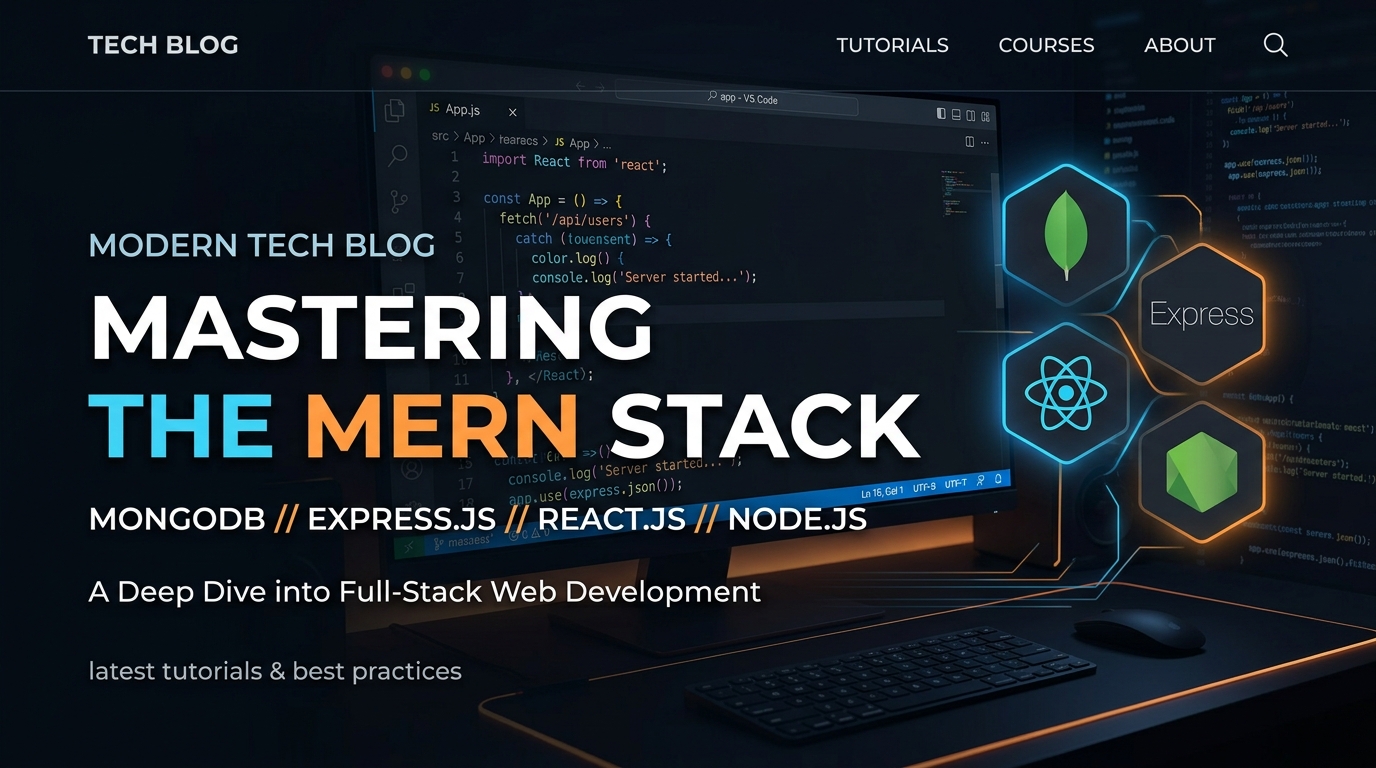
The Stack That Refuses to Age
Every year, new frameworks pop up and the tech world buzzes with "X is dead" takes. Yet here we are in 2025, and the MERN stack — MongoDB, Express.js, React, and Node.js — continues to power a massive chunk of the web. From startups launching their MVPs to enterprises scaling their platforms, MERN has proven that it isn't just a trend. It's a foundation.
When I first started learning web development during my second year of college, I was overwhelmed by the choices. Django or Express? Angular or React? PostgreSQL or MongoDB? After weeks of research and experimentation, I chose MERN — and it has been one of the most rewarding decisions of my development journey.
JavaScript Everywhere: The Killer Advantage
The single biggest advantage of MERN is that you write JavaScript across the entire stack. Frontend? React with JSX. Backend? Node.js with Express. Database queries? MongoDB's native query language maps beautifully to JavaScript objects. This consistency dramatically reduces the cognitive overhead of context-switching between languages.
For a solo developer or a small team, this is a superpower. When I was building Gyan Manthan during my IBM internship, I moved seamlessly between writing React components for the progress dashboard, Express middleware for rate limiting, and MongoDB aggregation pipelines for user analytics — all in the same language, sometimes in the same coding session.
React: The Frontend King
React's component-based architecture fundamentally changed how we think about building UIs. In 2025, with React 19 bringing improvements like the React Compiler and Server Components becoming mainstream, the framework has only gotten better. The ecosystem is enormous — React Router, Redux Toolkit, Zustand, Framer Motion, Tailwind CSS — you can find battle-tested solutions for virtually any UI challenge.
What I love most about React is its flexibility. It doesn't force you into a rigid pattern. When I built the reading plan generator for Gyan Manthan, I used Zustand for lightweight state management instead of Redux because the app didn't need the overhead. React let me make that choice without fighting the framework.
Node.js and Express: Simple, Fast, Scalable
Express.js is often criticized for being "too minimal," but I see that as its greatest strength. It gives you the building blocks — routing, middleware, error handling — and gets out of your way. You architect your backend the way your project demands, not the way the framework dictates.
Node.js itself continues to evolve. With native support for ES modules, the fetch API built-in, and improved performance with each V8 engine update, it's faster and more developer-friendly than ever. For I/O-heavy applications like real-time chat, API gateways, or content management systems, Node's event-driven architecture is genuinely hard to beat.
MongoDB: Flexibility When You Need It
Relational databases are fantastic when your schema is well-defined and stable. But in the real world — especially during rapid prototyping or building projects with evolving requirements — MongoDB's schema-flexible approach is invaluable. I've lost count of how many times I've added a new field to a document without running a migration script.
MongoDB Atlas has also made deployment and scaling incredibly accessible. With free-tier clusters, built-in monitoring, and one-click scaling, even student developers like me can deploy production-ready databases without infrastructure headaches.
The Ecosystem and Community
Perhaps the most underrated aspect of MERN is the sheer size of its community. Stuck on a problem? There are thousands of Stack Overflow answers, YouTube tutorials, and GitHub repos to learn from. Need a package? npm has over 2 million packages. This isn't just convenience — it's a massive accelerator for learning and building.
When NOT to Use MERN
I believe in being honest about limitations. MERN isn't the right choice for every project. CPU-intensive applications like video processing or complex mathematical computations would benefit from languages like Go, Rust, or Python. Applications requiring strict ACID compliance across complex relational data might be better served by PostgreSQL with a framework like Django or Rails.
The key is understanding your requirements and choosing the right tool. For the vast majority of web applications — SaaS products, content platforms, e-commerce sites, dashboards, and APIs — MERN delivers exactly what you need with an excellent developer experience.
Final Thoughts
MERN isn't just relevant in 2025 — it's thriving. The stack has matured, the tools have improved, and the community continues to grow. For aspiring full-stack developers, it remains one of the most practical and employable skill sets you can develop.
If you're starting your web development journey, give MERN a serious shot. Build something real. Deploy it. Break it. Fix it. That's how you learn, and MERN makes that learning loop faster than almost any other stack out there.